Begin with one controlled drawing set
Identify the product family, drawing number and current revision. Include the dimensions that define the finished product, its joints and any openings or cast-in features. Use a marked drawing to distinguish information that is approved from details still under discussion. Resolve conflicting sketches before treating the quotation as final.
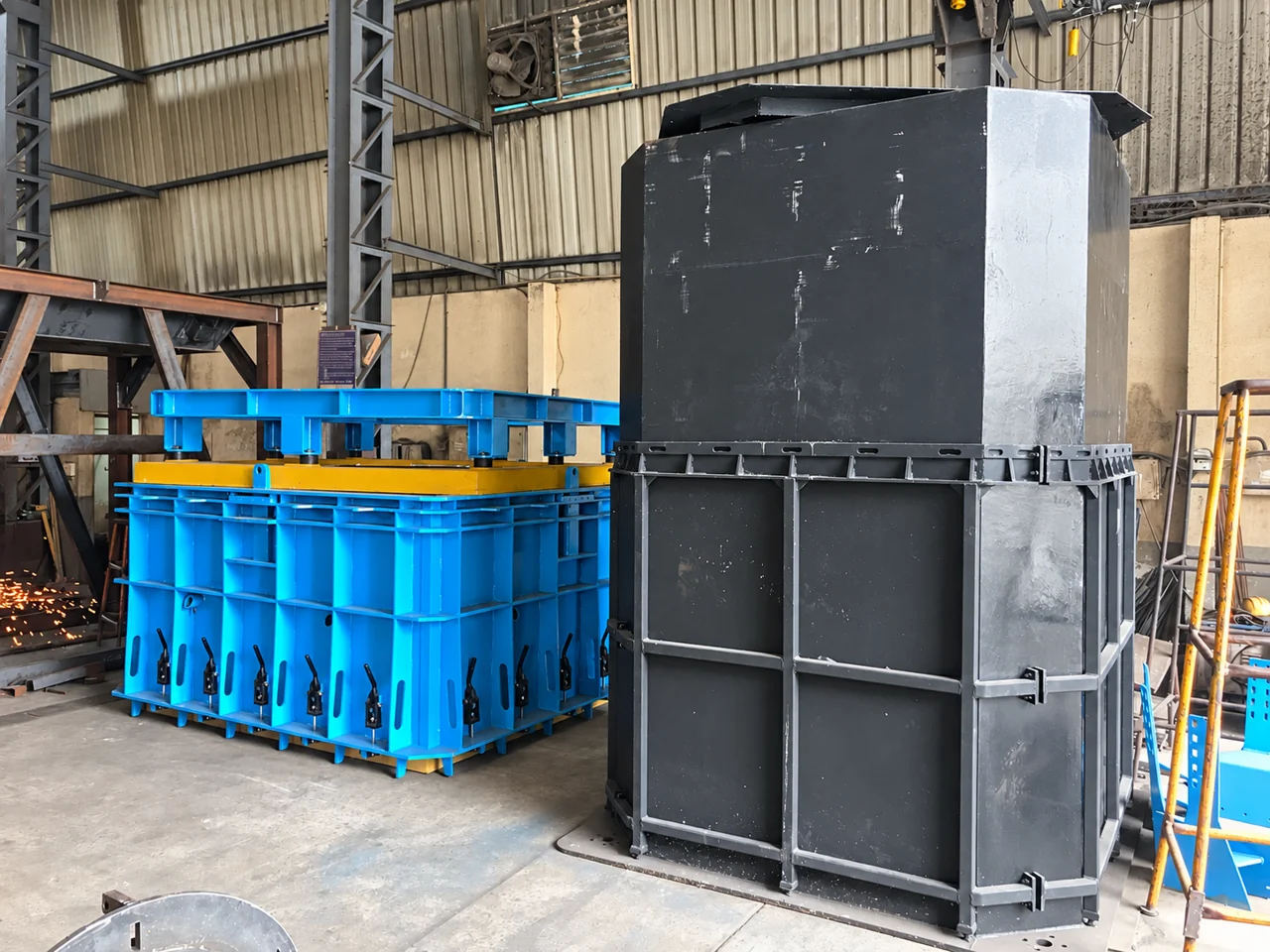
For replacement moulds, supply the original drawing if available and explain what has changed since the earlier purchase. Photos can clarify an arrangement, but they should support measured information. A photograph without scale or a reliable reference dimension cannot establish whether a new mould will fit an existing interface.
- Product drawing and revision, with units clearly stated.
- Required joint profiles, openings and interface details.
- Reinforcement drawings or constraints relevant to mould assembly.
- Known production difficulties that the replacement should address.
Describe the machine, pallet and handling interfaces
Record the equipment with which the mould must operate, including available identification plates and relevant drawings. Ask the supplier which interface measurements it needs. These may concern location, fixing, support, pallet arrangements or the connection to other production equipment; the correct list depends on your system.
Identify who will verify measurements on site and who will approve the final interface drawing. Do not assume that two moulds producing the same nominal product are interchangeable. If an existing pallet or machine component is to be retained, make that part of the agreed supply scope and compatibility review.
Explain the intended production sequence
Describe how operators will assemble the mould, prepare it, place reinforcement, introduce concrete, demould the product and return the mould for its next use. The purpose is to give the supplier a practical view of your operation, including access and maintenance needs.
For a family of sizes, distinguish components that remain fixed from those that must be changed. Ask what changeover requires: tools, lifting equipment, storage space, replacement parts and trained operators. Discuss the proposed demoulding and handling arrangements with the responsible technical team rather than selecting them from appearance alone.
Make inspection requirements specific
Ask your product designer or quality team which dimensions and features are critical to acceptance. Put those requirements on the agreed drawings, with the intended measurement method where needed. A single general tolerance in a marketing description may not communicate what matters at a particular joint or mating interface.
Agree what evidence the supplier will provide before dispatch. Depending on the order, this could include dimensional inspection records, assembly checks or a product trial. If a trial is required, define who supplies the materials, how the result will be evaluated and how any changes will be authorised. Avoid leaving acceptance to a general promise of a good finish.
Plan ownership beyond the first casting
Discuss cleaning access, inspection points, replaceable components and the information needed to maintain the mould. Ask for the recommended care procedure for the proposed materials and finish. Include storage arrangements, particularly for moulds used intermittently or for size-change components that must remain identifiable.
Treat claimed service life as a question about conditions and evidence. Ask what use, maintenance and repair assumptions sit behind any estimate. An accurate component list, clear identification and a route to replacement parts can be more useful to day-to-day planning than an unsupported lifetime number.
Close the enquiry with a clear scope schedule
List every supplied item: mould sections, cores, pallets, change parts, fixtures, documentation and any agreed spares. State which existing items the proposal relies on. Record delivery expectations as a discussion point, with drawing approval and other dependencies made explicit.
For an initial discussion with Param Machines & Moulds, send the latest product drawing, photographs of the existing production arrangement and a short explanation of the intended improvement. Identify the person who can answer interface and acceptance questions. This helps keep commercial decisions connected to the technical brief.
Continue your project
Common questions
Are product dimensions enough to specify a replacement mould?
They are a starting point. The supplier also needs the relevant machine, pallet and handling interfaces, along with the approved joint details and acceptance requirements. Confirm which measurements must be checked on site.
Should I request a universal tolerance for every mould?
Ask your responsible designer or quality team to identify the critical dimensions and their acceptance limits. Make those requirements explicit on the agreed drawings rather than relying on a broad marketing tolerance.
Can photographs replace drawings?
Photographs are useful for explaining condition, access and production sequence. For a final specification, support them with reliable dimensions and an agreed drawing that identifies the product and equipment interfaces.
Further reading
- NPCA utility structure manufacturing manual: background on forms and production quality ↗
- Explore Param’s product range ↗
This guide supports an initial equipment discussion. Confirm product requirements, equipment scope and site-specific obligations with your project team.
Turn your plan into an enquiry.
Share your drawings, product range and project location. We can discuss the equipment you are considering.
Prepare your project enquirySouth Africa project checklist
Plan around your actual product mix and existing plant. South African precast terminology includes manholes, stormwater pipes, catchpits and rectangular portal culverts. A portal culvert is a particular configuration, not a synonym for every closed box culvert. Share metric drawings and the specified product requirements.
Explore local buying guidance ↗