
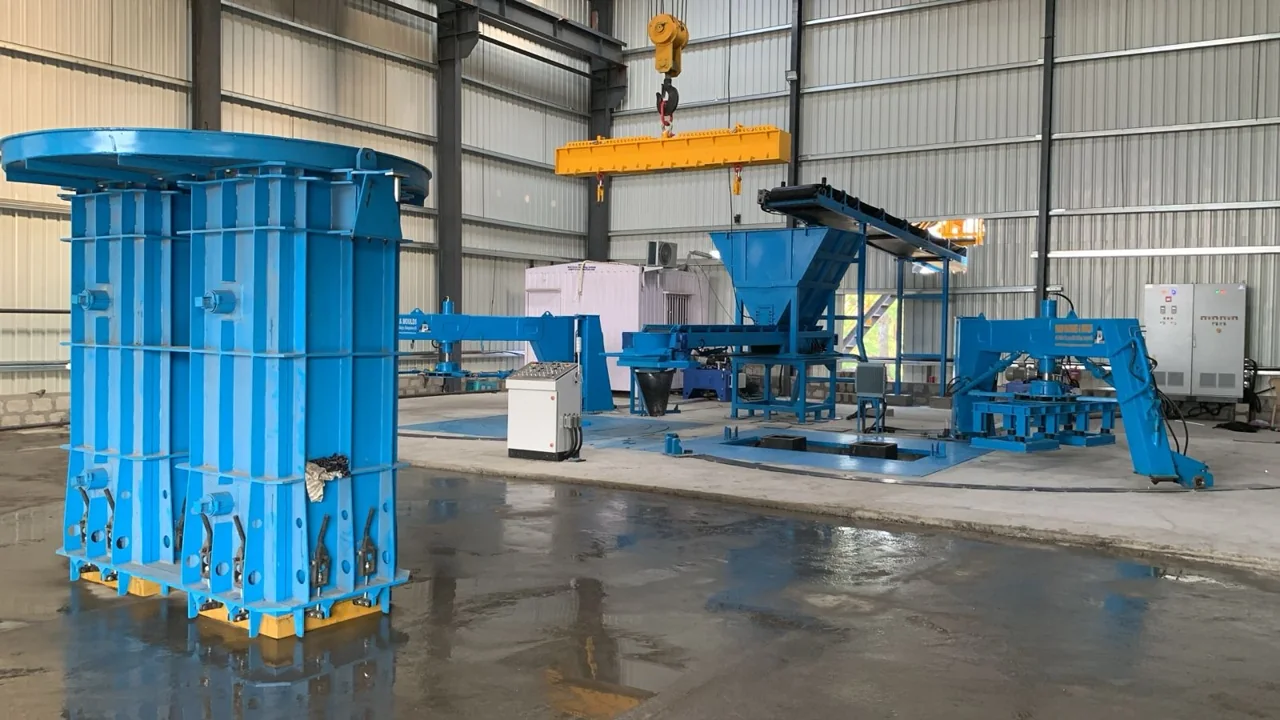
Translate the sales plan into a product mix
Start with the products you expect to make: pipes, culverts, U-drains, manhole components or a defined combination. Separate regular orders from occasional products and future possibilities. Record the expected volume and frequency of each size, plus any customer delivery patterns that affect production planning.
This is more useful than a single ambitious daily-output target. It lets your team discuss which products should share equipment, which require dedicated moulds and which might be introduced later. Document the assumptions behind the plan so a change in market demand can be reflected in the equipment discussion.
Draw the complete movement of work
Create a simple flow diagram for receiving, material storage, reinforcement preparation, mould preparation, concrete supply, casting, demoulding, curing, inspection, storage and dispatch. Adapt it to your intended process. Add where workers, forklifts, cranes and delivery vehicles need access.
Walk through a representative product on the plan. At each stage, ask where it waits, how it moves and what must be ready before the next step starts. Include returning pallets, empty moulds, mould changes and rejected or held products. These movements are easy to miss when the layout shows only major machines.
- Incoming materials and their inspection or storage points.
- Concrete and reinforcement delivery to the casting operation.
- Product handling, curing and quality-release steps.
- Mould return, maintenance access and outbound loading.
Check the dependencies behind the output target
Ask the proposed equipment supplier what concrete supply, reinforcement availability, staffing and handling resources its output estimate assumes. Compare those assumptions with your intended operation. A fast casting step cannot by itself explain whether the whole plant will achieve the required delivery programme.
Use a simple worksheet to record each stage’s required capacity, proposed resources and unresolved questions. Review the plan for your most frequent product and for a more demanding changeover day. If the plant will grow in phases, identify the equipment or space that would need expansion next. This creates a practical basis for investment priorities.
Give curing, inspection and storage their own plan
Treat curing and quality release as defined parts of production. Ask the responsible technical team to specify the process and the criteria for each handling or release step. Reserve suitable space in the layout and identify how products will remain traceable while they are waiting for checks or dispatch.
Plan access to inspect products and to keep accepted stock distinct from items on hold. Discuss how the yard will operate when customer collection is delayed or several product sizes are stored together. The NPCA quality-control resources provide broader context on managing consistent plant operations; the procedure for your products must be established for your own project.
Agree the boundary between machinery and site works
Request the supplier’s installation information and review it with the professionals responsible for the building, foundations, lifting equipment and utilities. Establish who designs, supplies, installs and checks each element. Include access for unloading and assembly, plus the space required for routine service.
For an existing plant, record what must continue operating during installation and which connections or movements will be affected. For a new plant, connect the civil-work and utility programme to equipment delivery. A responsibility schedule makes it easier to see whether the site can actually receive and commission the machinery when planned.
Plan commissioning as a staged handover
Define the sequence from installation checks to operator training, trial production and agreed acceptance. Name the people who will attend and the records they need. Discuss how unresolved issues will be logged, who will close them and which information the production and maintenance teams receive at handover.
Keep the first production brief focused: product schedule, site layout, existing equipment, utility details and the desired starting date. Param Machines & Moulds can use those inputs to discuss the machinery and mould requirements. The final project should bring the equipment proposal together with your site design, staffing, quality plan and operating procedures.
Continue your project
Common questions
Should I choose the machine before planning the factory layout?
Develop them together. An initial product and workflow brief helps identify machinery options; supplier installation requirements then inform the layout. Avoid finalising foundations or building changes before those requirements are reviewed.
Can one production line serve several product families?
Discuss the specific products, moulds and changeovers with the supplier. Shared equipment may be proposed for a particular configuration, but capacity and compatibility must be assessed against the actual mix rather than assumed.
What information is useful for a first plant-planning discussion?
Bring the product schedule, target order mix, site dimensions, current equipment, utility information and a sketch of material and product movements. Include the people responsible for production, quality and site works.
Further reading
- NPCA: quality-control resources for precast plant operations ↗
- Explore Param precast machinery categories ↗
This guide supports an initial equipment discussion. Confirm product requirements, equipment scope and site-specific obligations with your project team.
Turn your plan into an enquiry.
Share your drawings, product range and project location. We can discuss the equipment you are considering.
Prepare your project enquirySaudi Arabia project checklist
Identify the owner, package and selected concrete products before specifying production equipment. The approved product drawings govern the mould design. Supply dimensions in millimetres and the factory plan in metres, with the applicable authority and project specification.
Explore local buying guidance ↗