Inside vertical vibration
A pipe.
A process.
Pure precision.
Discover how concrete takes shape. One production cycle, brought to life as you scroll.
Explore the process ↓Read the overview ↗01 / 09 Jacket locking
Lower the jacket.
Secure the base.
With the reinforcement cage already seated on the pallet, the outer form jacket is lowered around it. The jacket-to-pallet locking clamps engage, securing the assembly for transfer to the machine.
Outer jacket + pallet locking clamps
02 / 09 Core loading
One assembly.
Lowered over the core.
The locked jacket, pallet and reinforcement cage are lifted together, positioned above the inner form and lowered onto the production station. The core defines the bore; the jacket defines the outside of the pipe.
The space between them defines the pipe wall
03 / 09 Concrete feeding
Feed the mix.
Build the wall.
Low-slump concrete is fed into the annular space between the core and jacket. Controlled distribution builds the pipe progressively around the reinforcement cage.
Feeding and vibration overlap
04 / 09 Vibration
Compact from
within.
The core vibrator transfers energy into the concrete during filling. The mix consolidates around the reinforcement, reducing entrapped air and filling the form profile.
Settings suit the concrete mix and product
05 / 09 Pressing
The head arrives.
The top takes shape.
After filling, the pressing head moves above the form and descends to compact and shape the upper end of the pipe. It then rises and moves clear for lifting.
Upper joint geometry follows the product drawing
06 / 09 Beam engagement
Engage the beam.
Prepare to lift.
With the pressing head clear, the lifting beam descends and engages the jacket's lifting points. The pallet remains locked to the jacket so the fresh pipe stays supported during transfer.
Jacket, pipe and pallet move together
07 / 09 Lift & transfer
Lift clear.
Move as one.
The lifting beam raises the jacket, fresh concrete pipe and pallet clear of the fixed core. Once clear, the supported assembly travels to the floor-level demolding position.
The pipe remains enclosed and pallet-supported
08 / 09 Set-down
Set it down.
Release the locks.
The assembly is lowered until the production pallet is supported on the floor. The jacket-to-pallet locking clamps are then released, ready for the outer jacket to be removed.
The pallet stays beneath the fresh pipe
09 / 09 Demolding
Lift the jacket.
Reveal the pipe.
The beam lifts the outer jacket vertically away, leaving the freshly formed pipe on its pallet. Controlled curing and the specified inspections follow before the product is ready for service.
Fresh concrete retains its shape; curing develops strength
The principle behind the process
Shape the space.
Compact the mix.
Release the product.
Vertical vibration forms concrete products in an upright form. A controlled concrete feed and vibration work together to compact low-slump concrete between the form surfaces. The reinforcement cage and outer jacket are first assembled on a pallet, then lowered over the inner core. After compaction and upper-end forming, the lifting beam transfers the assembly to the floor for demolding.
This story follows a reinforced concrete pipe through an illustrative fixed-core cycle. The nine chapters follow jacket locking, loading over the core, feeding, vibration, pressing, beam engagement, transfer, set-down and demolding. Feeding and vibration overlap.
Illustrative assembly, with selected parts opened in cutaway. Actual machinery, vibration arrangements, release sequences and controls vary by configuration. Dimensions, timing and motion are simplified; this is a process explanation, not an operating procedure.
View the illustrated, non-animated version ↗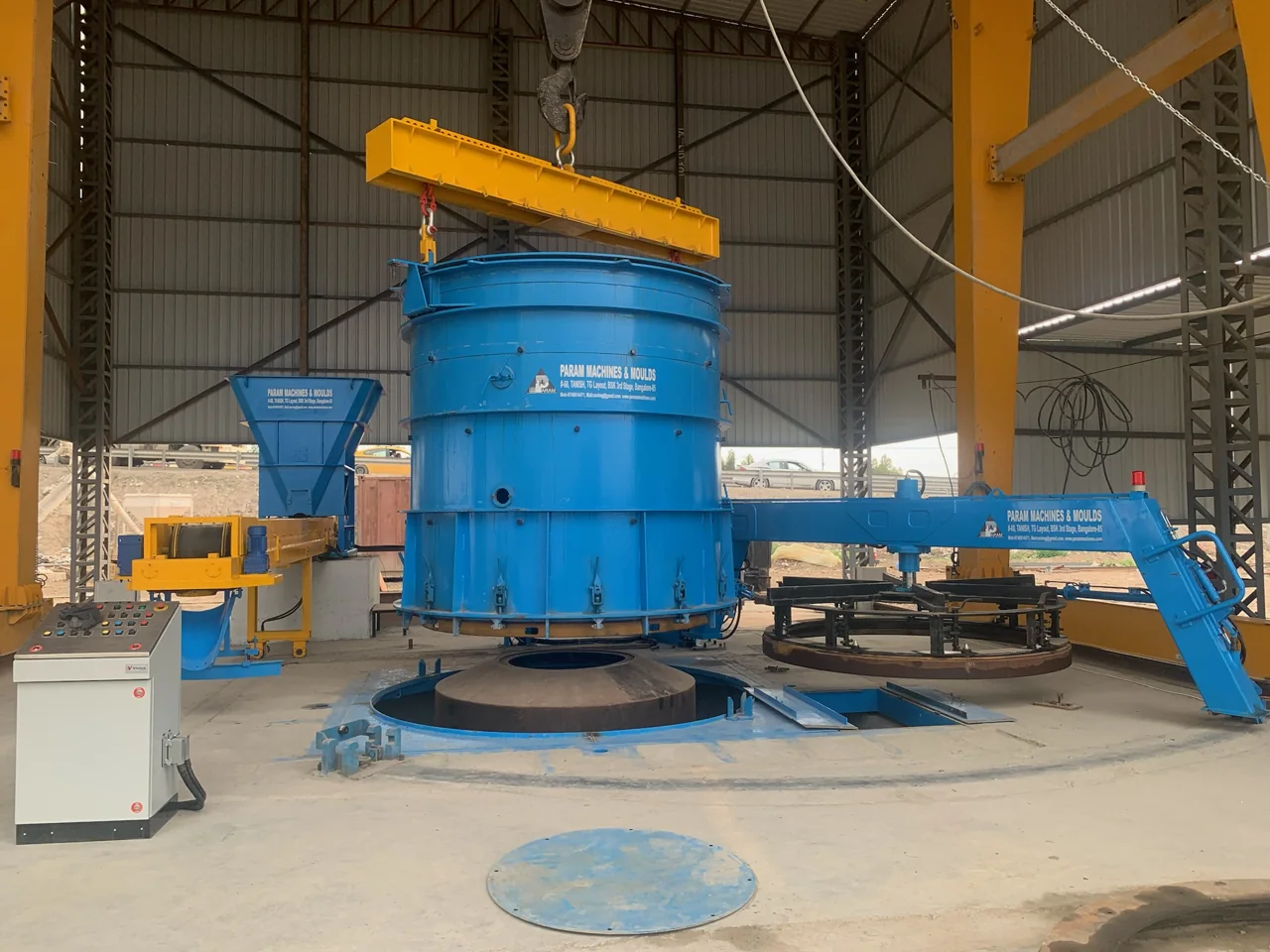 THE REAL MACHINERY / WATCH THE FILM ↗
From the illustration to the workshop
See the engineering
in action.
Explore Param’s pipe and box-culvert machinery on film, then start with the products you want to manufacture.
Explore pipe machinery ↗Build a production concept ↗Discuss your project ↗A little more detail.
Why does concrete hold its shape after demolding?
A suitable low-slump mix, compacted with the appropriate forms and process, can retain its shape as fresh concrete. It still requires supported handling and controlled curing to develop the specified strength.
Does vibration happen after the form is full?
In the process illustrated here, vibration and feeding overlap. Even, controlled feeding lets the mix compact progressively. The equipment settings and sequence must suit the concrete mix and product.
Can this process make products other than round pipes?
Vertical vibration equipment can be configured for other precast products, including box culverts and U-drains. Product geometry, forms, reinforcement and handling need to be considered together. Discuss the required range with Param.
About this illustration and its sources
The visual design references Param’s workshop photographs. The cutaway is an explanatory model, not a CAD representation of a particular machine. The nine-stage handling sequence follows Param’s description of its machine cycle. Background on vertical vibration and concrete compaction comes from Param’s pipe machinery information and the National Precast Concrete Association’s dry-cast compaction guidance (September–October 2017, page 4). No production capacity, approved product design or certification is implied.