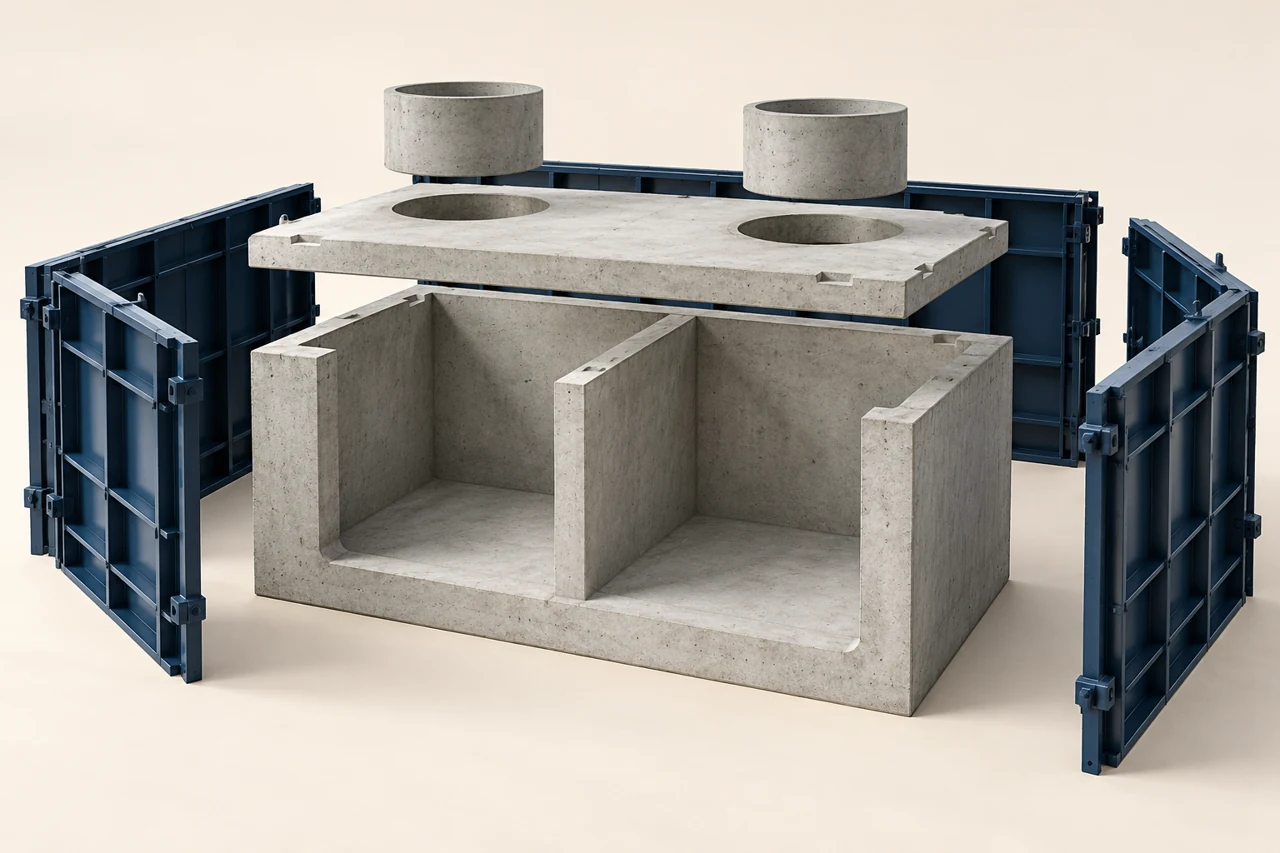
Build your next septic tank range around the capacities, approved drawings and production process your customers need. Param custom-builds steel forms for precast concrete tanks, with each project developed around the buyer’s tank geometry, compartment layout and plant requirements. Start with a familiar US-gallon capacity or share a custom design for a larger tank, low-profile configuration or specialist application.
Capacity options are production-inquiry targets, not a national sizing schedule or preapproved tank models. Nominal volume and effective liquid capacity can differ. The final tank design and its approval requirements follow the project jurisdiction.
Plan the capacity range before the forms
Use 1,000, 1,250, 1,500, 2,000, 2,500 and 3,000 US gallons as starting points for a production inquiry, with other capacities specified separately. These are examples found in US tank listings, not a national sizing schedule. The Kansas health department’s August 2026 list includes concrete products across several of these capacities; Georgia’s April 2026 list also includes larger concrete tank ranges. Smaller 750-gallon and larger custom configurations may be relevant to particular markets, subject to the project requirements.
Specify the required effective liquid capacity and its measurement basis. A catalog model name, total internal volume and working liquid volume are not automatically interchangeable. The outlet elevation, internal partitions and tank geometry affect the usable liquid volume. For example, Massachusetts’ regulation refers to effective liquid capacity below the outlet invert. Confirm the applicable definition on the approved drawing rather than sizing a form from a nominal gallon label alone.
Define the tank and every interface
Provide the internal and external dimensions in feet and inches, wall and base thicknesses, the roof arrangement and the intended joint detail. Include the compartment arrangement, partition geometry, inlet and outlet openings, access openings, risers and cover interfaces. If your range includes separate septic, pump, holding or combination tanks, identify each application and the liquid volume assigned to each chamber.
A two-compartment tank is an important US configuration, but the exact arrangement must follow the applicable requirements. Washington, for example, requires at least two compartments and specifies how the total liquid volume is divided. A form for one jurisdiction or one approved tank drawing should not be assumed suitable for every US project.
Match the form to your production process
Tell us whether the proposed tank is monolithic or sectional, how the concrete will be placed and consolidated, and how each casting will be released, lifted and moved. Share the planned daily output, available crane capacity, curing approach, factory access and existing form interfaces. These details help define the form arrangement, removable components and the practical changeover between sizes.
For a family of tanks, separate the features that remain constant from those that change. A consistent joint or access-opening detail may be useful across a range, while another capacity may require different geometry or reinforcement. Confirm the approved tank design first; production flexibility should not depend on an unverified assumption that changing height alone preserves structural or hydraulic performance.
Build around the specified standard and local approval
ASTM C1227-25 is the active specification for precast concrete septic tanks at the review date. Its scope covers tank design, manufacture and performance, and it uses inch-pound units as the standard units. Include the edition required by your project, together with the state or local authority’s tank approval requirements, in your inquiry.
Form manufacture and approval of the finished septic tank are separate responsibilities. The tank design must address its actual burial conditions, groundwater, loading, reinforcement, openings and watertightness requirements. Param’s form proposal will be based on the agreed drawings and manufacturing scope; it does not itself establish a tank’s regulatory approval or a universal traffic rating.
Send a production brief
Start with your target capacities in US gallons, project state, tank drawings, required units per day and preferred casting process. Add dimensions, compartment layouts and any existing form, pallet or lifting interfaces. Param can then review the custom form requirements and prepare a project-specific discussion. If the tank design is still in development, mark those details as provisional so the quotation and engineering stages stay aligned.
Make your tank range a production plan.
Share your capacity schedule, drawings and factory requirements.