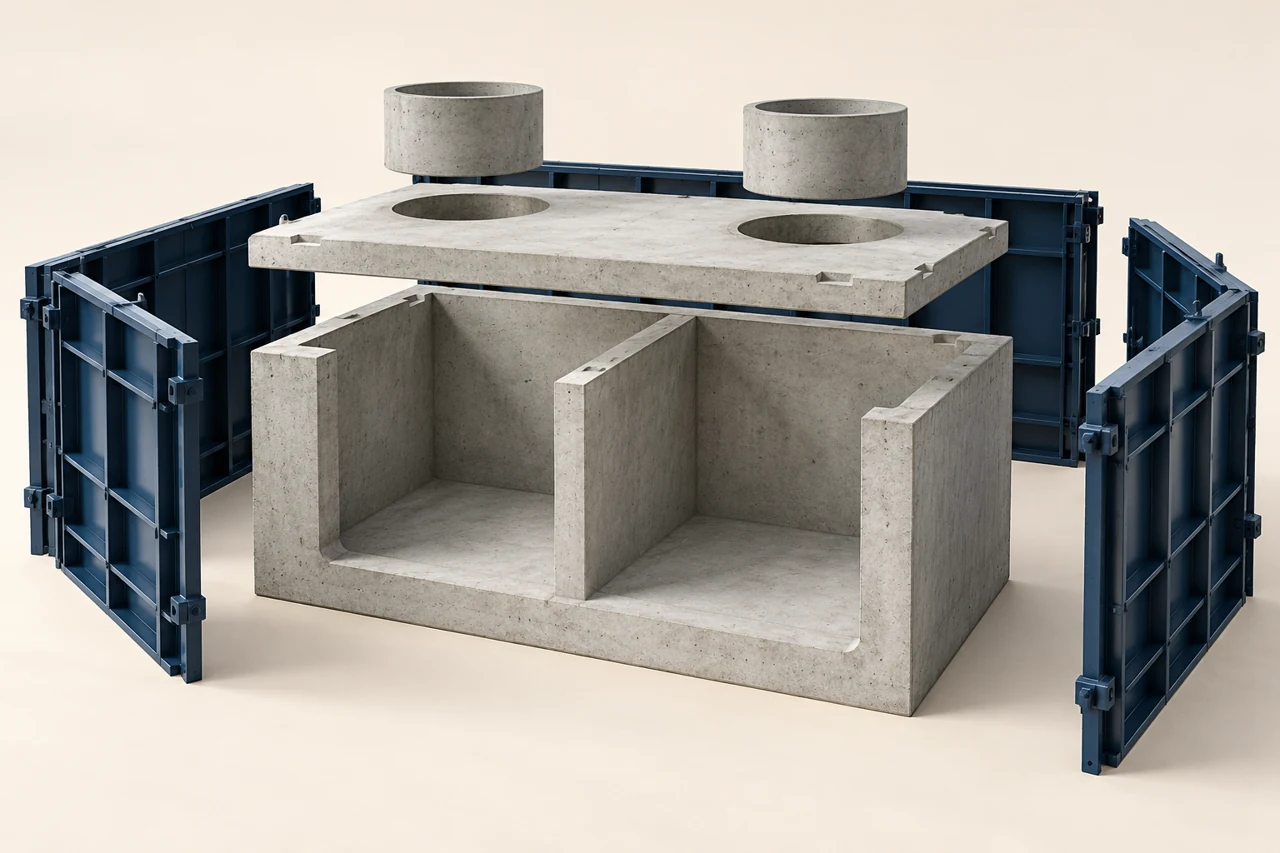
Param custom-builds steel moulds for precast concrete septic tanks. Define the tank geometry, effective liquid capacity, compartments and production process, then develop the moulds around the agreed drawings and local project requirements.
Provide the required effective liquid capacity in litres or cubic metres, together with the tank length, width, depth and outlet elevation. A capacity label alone does not define the mould. Include the compartment arrangement, openings, access risers, covers and joint details.
Custom moulds for your casting process.
Discuss monolithic or sectional construction, concrete placement, removable components, lifting, curing and the intended product mix. For a family of sizes, identify which details remain constant and which require separate moulds or inserts.
Develop the mould around the project design.
Tank design and local approval requirements depend on the application and project location. Provide the applicable specification, loading and groundwater assumptions, reinforcement drawings and watertightness requirements. Param develops the moulds around the agreed tank drawings and manufacturing scope.
Australia / production brief
Stormwater, culverts & maintenance holes
Start with the asset owner’s drawings and the relevant Australian or AS/NZS product specification. Sewer maintenance holes, stormwater pits and box culverts serve different functions; define each component before planning the mould. Use millimetres for products and metres for the factory layout.
State, council or utility requirements and adopted standard edition
Maintenance-hole, pit or culvert drawings with joints and openings
Existing plant interfaces, lifting and installation scope