
Publisher records checked on 30 October 2026. This guide identifies scope and purchasing questions; the responsible engineer must confirm the documents, editions and approval requirements for each project.
Begin with the contract and the product
Ask for the specification actually attached to the order or tender, including amendments, drawings and any owner supplements. Record the document edition alongside each product family. A newer publisher edition may exist while a contract calls for an earlier one; resolve that difference with the purchaser before changing the design or buying moulds.
Create separate rows for the finished product, joints, testing, installation and any required plant approval. Give each row an owner within the project team. This prevents a general statement such as “international standards” from replacing the concrete acceptance requirements that the factory needs to satisfy.
India: identify the pipe reference and avoid a misleading shortcut
BIS lists IS 458:2021 for precast concrete pipes with or without reinforcement, with a first amendment issued in 2024. Confirm the specified pipe category, joint details and applicable edition through the project documents and the official BIS record.
IS 15916:2020 concerns building design and erection using prefabricated concrete. It should not be presented as a generic box-culvert product standard. For a culvert enquiry, obtain the owner-approved structural drawings and the applicable road, railway or other authority requirements from the designer. Do not transfer a pipe specification to a rectangular culvert simply because both products are precast.
USA: distinguish the product and the unit system
ASTM lists C76-25 as active for reinforced concrete drainage, sewer and culvert pipes. Its published scope describes a manufacturing and purchase specification, with field installation considerations addressed separately. This distinction matters when a machinery quotation is being used to plan the whole project.
For monolithically cast, single-cell reinforced concrete box sections, ASTM lists C1433-25 and the metric companion C1433M-25. Record the exact designation and units in the enquiry. Have the project engineer determine whether these or another specified design route apply; similarly named documents are not automatic substitutes.
Australia: check the appropriate part and its amendment status
Standards Australia lists AS/NZS 4058:2007 for circular precast concrete pipes for pressure and non-pressure applications. The AS 1597 series addresses reinforced concrete box culverts: Part 1 covers small culverts and Part 2 covers larger culverts within its defined scope.
At this review, the publisher marked AS 1597.1-2010 as pending revision and identified Amendment 1:2018; AS 1597.2-2013 was listed as current. Check again when preparing an order. Austroads ATS 2235-25 also sets supply requirements and modifies how AS 1597 applies where that specification is adopted. Ask which authority supplements govern the actual contract.
Turn the selected requirements into an equipment brief
Use the standards review to ask better questions rather than to attach a compliance slogan to a machine. The approved concrete product is the starting point; mould interfaces, process requirements and inspection arrangements follow from it.
- Attach controlled product and joint drawings, with units and revision dates.
- Identify the product families and size mix that must share the production system.
- List the inspections, trials and documentation the buyer expects before acceptance.
- Assign responsibility for reinforcement, materials, testing, installation and product release.
- Request a written record of unresolved assumptions and proposed deviations.
Keep equipment acceptance separate from product acceptance
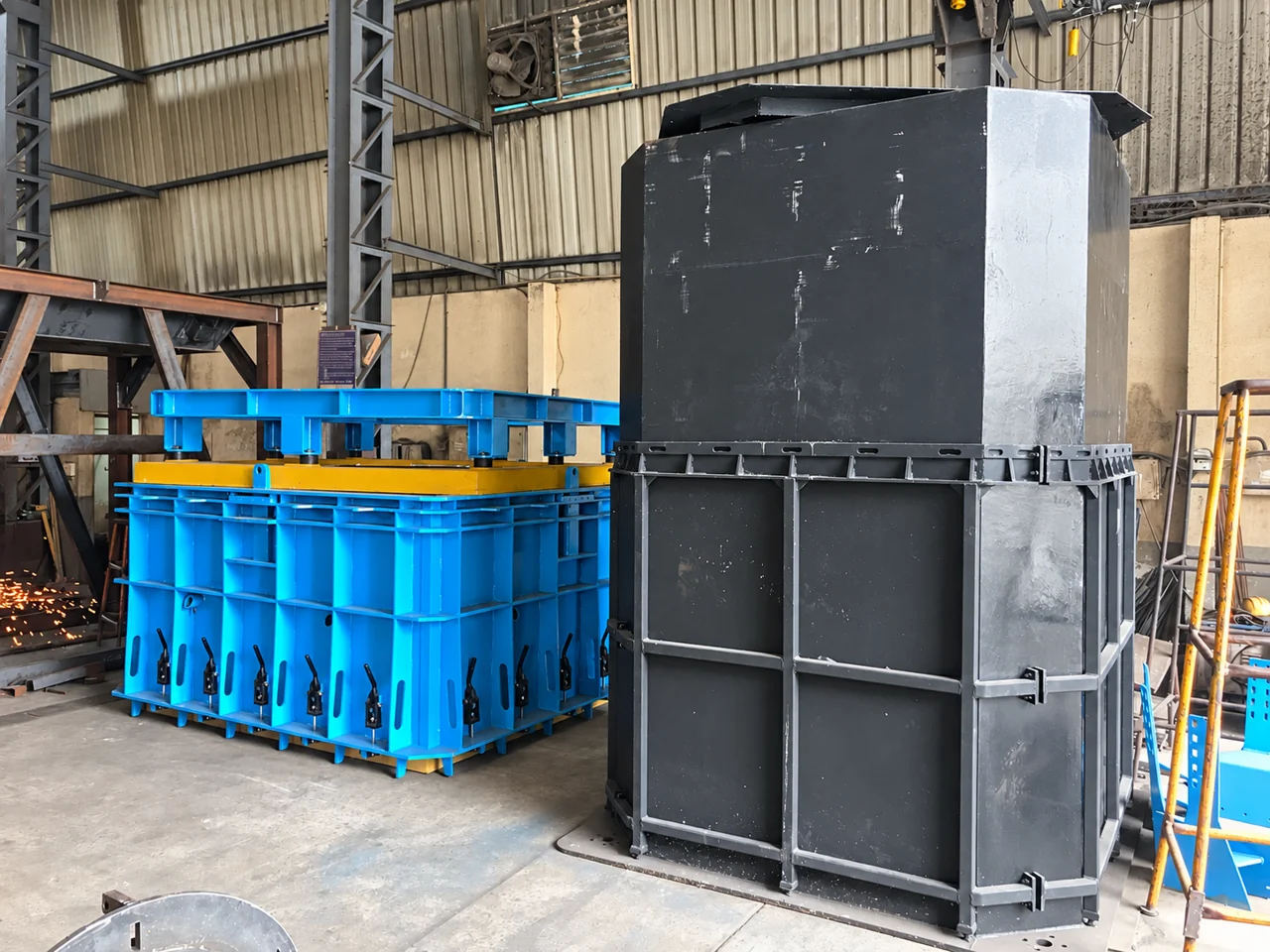
A machinery trial can demonstrate an agreed operation, but it does not by itself approve every future concrete product. Define what will be checked on the equipment, what will be checked on trial products and who can accept each result. Send Param Machines & Moulds the drawing schedule and project specification so the pipe machinery, culvert moulds and steel pallets can be discussed against a shared brief.
Continue your project
Common questions
Does a concrete-pipe machine have an IS 458 or ASTM C76 certificate?
Those references concern concrete products. Ask precisely what any certificate covers and who issued it. Equipment suitability, plant approval and acceptance of finished pipes are different questions; buying a machine does not establish product compliance.
Is IS 15916 the Indian box-culvert standard?
BIS identifies IS 15916:2020 as a code for prefabricated concrete building design and erection. Obtain the culvert project’s approved design and applicable authority specifications rather than using it as a general culvert product reference.
Can the same moulds serve products for several countries?
Possibly, but the relevant drawings, joint geometry, reinforcement interfaces and acceptance requirements must be compared first. Confirm compatibility for the proposed configuration; a shared nominal diameter or span is insufficient.
Further reading
- BIS: IS 458:2021 and amendment record ↗
- BIS: IS 15916:2020 scope and title ↗
- ASTM: active C76-25 specification and scope ↗
- ASTM: concrete standards catalogue including C1433-25 ↗
- ASTM: C1433M-25 metric box-section specification ↗
- Standards Australia: AS/NZS 4058:2007 ↗
- Standards Australia: AS 1597.1-2010 ↗
- Standards Australia: AS 1597.2-2013 ↗
- Austroads: ATS 2235-25 Supply of Box Culverts ↗
This guide supports an initial equipment discussion. Confirm product requirements, equipment scope and site-specific obligations with your project team.
Turn your plan into an enquiry.
Share your drawings, product range and project location. We can discuss the equipment you are considering.
Prepare your project enquiryAustralia project checklist
Start with the asset owner’s drawings and the relevant Australian or AS/NZS product specification. Sewer maintenance holes, stormwater pits and box culverts serve different functions; define each component before planning the mould. Use millimetres for products and metres for the factory layout.
Explore local buying guidance ↗